BeWhere Holdings: The Quiet IoT Compounder Hiding in Plain Sight
BeWhere Holdings (TSXV: BEW) has grown revenue every year since 2017 — from $1.7M to $21.5M — serving UPS, Costco, Boeing and Ford, and just connected an off-the-shelf device directly to a satellite. Here's what we found.
TSXV: BEW | Price: $0.71 | Market Cap: $69.9M | Shares Outstanding: 97.1M
Not financial advice. Always do your own research.
There's a small Ontario company that's been growing revenue every single year since 2017 — from $1.7M to $21.5M — serving UPS, Costco, Boeing, Toyota, Lyft, and Ford.
BeWhere Holdings makes rugged, battery-powered GPS trackers designed to stick onto trailers, generators, cable reels, first responder kits, and other unpowered assets that businesses need to locate and monitor. In October 2025, one of their standard off-the-shelf devices successfully connected directly to a satellite in low-Earth orbit — a first for the asset-tracking industry — without any specialized hardware.
Despite that milestone, the stock still trades at roughly 3x sales. The IoT/SaaS peer average sits closer to 8x.
What They Do
BeWhere builds Mobile IoT (M-IoT) devices — compact, rugged beacons that businesses attach to unpowered assets to monitor location, temperature, motion, and environmental conditions in real time. The devices run on AA batteries (some lasting 10 years) or solar power, transmit over low-power 5G cellular networks, and pipe data into cloud dashboards that customers can configure from anywhere.
The pricing is what makes this interesting. Legacy asset trackers run $200–$500 upfront with $25–$45/month software fees. BeWhere's devices land under $100 with monthly fees of $1–$5. That cost reduction unlocks entirely new categories worth tracking — pallets, cable reels, bike-share fleets, portable medical equipment, even portable toilets — things no company would bother monitoring at legacy price points. BeWhere didn't just take market share. They grew the market itself.
As the CEO put it directly: every time price points come lower, the total addressable market increases.
Since 2018, they've deployed roughly 500,000 devices across more than 10,000 companies — of which approximately 325,000–350,000 are actively generating recurring revenue right now.
How They Make Money
BeWhere runs a hardware-plus-recurring-revenue model with three purchasing options for customers:
- Outright purchase — pay for hardware upfront, pay monthly subscription fees
- Financing — $0 upfront, ownership transfers to the customer, BeWhere recognizes the hardware revenue immediately and collects monthly fees over a 3–5 year term
- True rental (DaaS) — $0 upfront, hardware stays on BeWhere's books, everything bundles into a higher monthly fee over a 36-month contract
In Q2 2026, recurring revenue hit a record $2.55M for the quarter, up 27% year over year. Annual Recurring Revenue (ARR) now stands at $12.0M — up 46% from $8.2M a year ago. Recurring revenue now exceeds total cash operating expenses, meaning the subscription base alone is funding the business. Every device sale adds to that.
The Distribution Engine
BeWhere sells almost entirely through distribution partners: AT&T, Bell Canada, T-Mobile, Geotab, and Ford Pro Telematics. Only a handful of the largest enterprise clients are served directly, where BeWhere wants close proximity to understand workflows and expand the relationship over time.
This model is deliberate. By giving up some product margin to partners, BeWhere gains access to AT&T's and T-Mobile's massive salesforces — which also removes a key competitive vulnerability: when competitors try to instill doubt about BeWhere's small size, it's AT&T or Bell walking into the room, not BeWhere.
Bell Canada is worth noting specifically. Bell is not just a distribution partner — it's a shareholder, owning approximately 6% of BeWhere. Combined with management's ~22% and employee ownership, total aligned ownership is approximately 30% of the company.
In February 2026, BeWhere completed the commercial soft launch of its integration with Ford Pro, the commercial vehicle division of Ford Motor Company. Ford Pro customers can now access BeWhere's fourth-generation tracking solutions directly through the Ford Pro Telematics ecosystem, gaining real-time insights that help reduce lost equipment, cut operating costs, and improve return on assets. According to the CEO, Ford Pro was ahead of schedule and ahead of their own forecasts early in the rollout — with additional opportunities within Ford itself still in the pipeline.
The Land and Expand Playbook
BeWhere's growth strategy with enterprise clients is best understood through the Costco story.
BeWhere started tracking Costco's entire owned fleet of trailers — over 10,000 units across the US and Canada. That relationship opened a second door: as Costco grew so fast it ran out of warehouse space, they started parking loaded shipping containers in their yards. BeWhere put a BeMini tracker on each incoming container; employees scan the QR code, tie it to the bill of lading, and can then search by product name to find exactly which containers hold a specific SKU. Now a third Costco project is underway: pallet tracking, integrating BeWhere's software with Costco's existing RFID infrastructure.
Three projects. One customer. That's the model.
The CEO estimates BeWhere has penetrated just 17% of the expansion opportunity within its existing enterprise accounts. If that figure reaches 50%, the potential units deployable within the current client base alone exceeds one million devices.
Competitive Position
BeWhere's moat comes from several reinforcing factors:
Price disruption is structural. Orbcom — the biggest name in trailer tracking, with revenues well over $1B — competes primarily on functionality and brand at premium price points. BeWhere competes by matching or exceeding that functionality at a fraction of the cost.
Open sensor architecture is a key differentiator. BeWhere allows manufacturers and clients to connect their own existing sensors directly to BeWhere's M-IoT devices, letting them use BeWhere's dashboards and cellular network without investing in a separate cellular device. This expands the addressable market without requiring BeWhere to build custom hardware for every use case.
Carrier relationships act as a distribution moat and an early-access pipeline. BeWhere's pattern of partnering with carriers on new wireless technologies before commercialization — as they did with low-power 5G in 2018–2019, and now with AST SpaceMobile's satellite network — means they arrive at market with working product on Day 1.
Switching costs are substantial. Once a company like Costco or UPS integrates BeWhere's devices and software into its core logistics workflows, the cost and disruption of switching is real.
Board depth is growing. In July 2026, BeWhere appointed Frank Pellitta to its board of directors. Pellitta is the founder of Assured Telematics Inc., a US-based enterprise fleet management provider he built and sold to Transflo in 2023, with 25 years of deep experience in connected vehicle ecosystems and custom enterprise fleet solutions. The CEO described him as a long-time collaborator in penetrating the Fortune 500 enterprise market.
Financial Snapshot
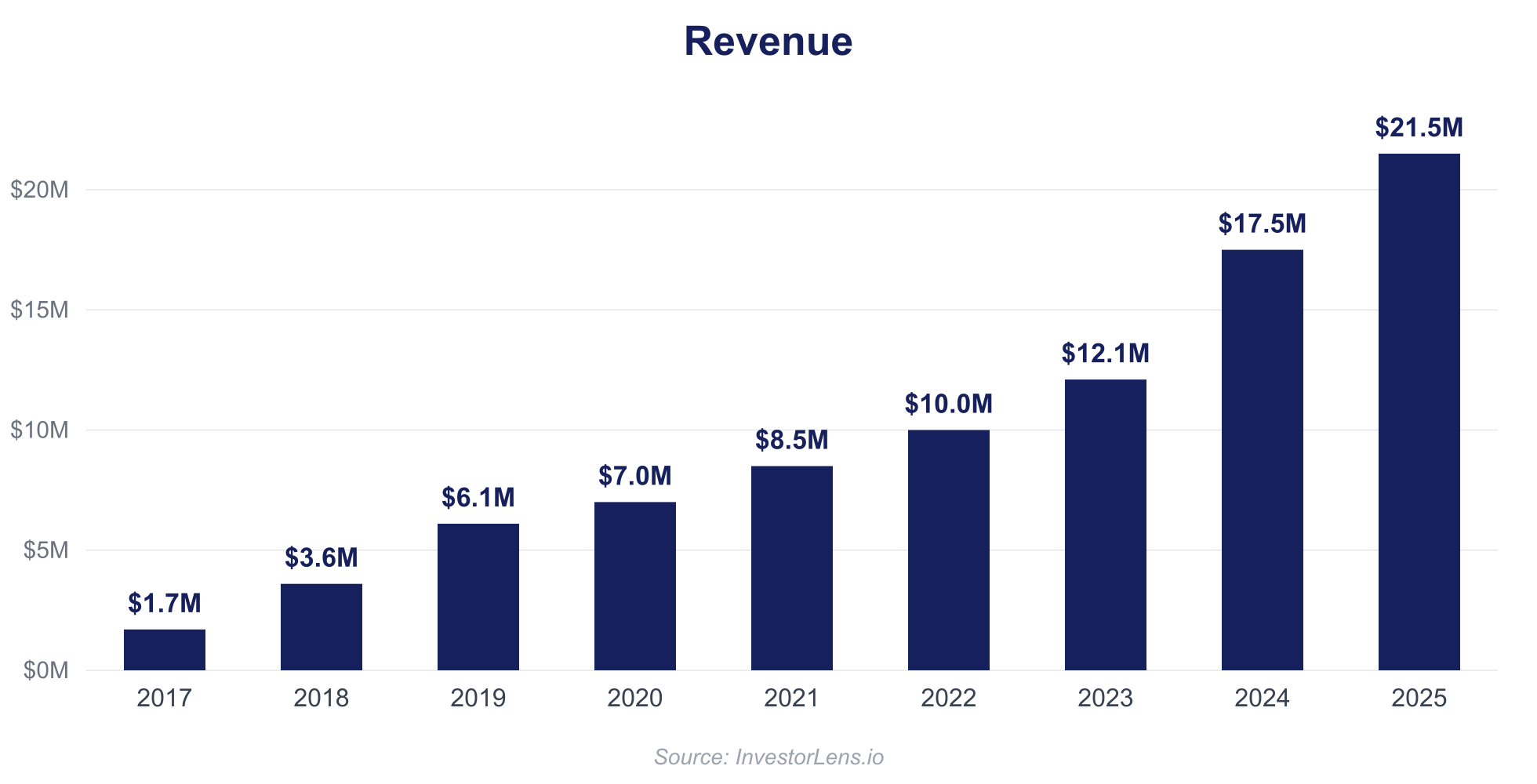
Revenue has grown every single year since 2017 — from $1.7M to $21.5M in 2025. That's not a lucky quarter or a one-time contract; it's a consistent compounding story across eight years.
The most recent full-year and quarterly results tell a healthy story:
- Full-year 2025 revenue: $21.5M — up 22% from $17.5M in 2024, a record level
- Full-year 2025 net income: $1.56M — profitable at the bottom line, not just on an EBITDA basis
- Q2 2026 revenue: $5.0M — recurring up 27% YoY, overall down 9% on lower hardware volumes
- Q2 2026 gross profit: $2.2M — a record, up 53% YoY; gross margin 44% vs 26% a year ago
- Q2 2026 Adjusted EBITDA: $967K — a record, up 56% YoY; EBITDA margin of 19.3%
- Q2 2026 comprehensive income: $652K — second highest in company history
- ARR: $12.0M as of June 30, 2026 — up 46% year over year
- 27 consecutive quarters of positive EBITDA — profitable for nearly seven straight years
- H1 2026 operating cash flow: $1.1M — up 41% from $783K in H1 2025
- Balance sheet: $9.1M cash after the SecureQuip acquisition, working capital of $13.0M
The Satellite Breakthrough
Most cellular networks only cover about 15% of Earth's land surface. For industries operating in remote areas, traditional satellite tracking has always been an option — just an expensive one: purpose-built terminals costing $500–$1,500 plus monthly data fees north of $50. The satellite-only asset tracking market is estimated at $6–12B today, and it's a market BeWhere has never been able to address with cellular-only devices.
In October 2025, BeWhere did something that hadn't been done before in asset tracking: a completely unmodified BeWhere LTE device, sitting in New Brunswick, Canada, transmitted location and sensor data directly through an AST SpaceMobile (NASDAQ: ASTS) BlueBird satellite — the largest commercial phased-array ever deployed in low-Earth orbit — and back down through Bell Canada's terrestrial network. No hardware swap. The same sub-$50 device, now capable of connecting from virtually anywhere on the planet with a firmware update.
BeWhere's carriers — Bell, AT&T, Vodafone — have all made substantial equity investments in AST SpaceMobile and are operationally committed to lighting up the service. That alignment is why BeWhere is focused on AST over alternatives: the carriers are the distribution channel, and they're fully behind it. This unlocks mining, oceangoing freight, fisheries, agriculture, and disaster-response scenarios where cell coverage simply doesn't exist.
Growing Through Acquisition
BeWhere's Vision 20/20 Plus three-year plan — targeting more than $20M in ARR exiting 2028 and a 20% Adjusted EBITDA margin — includes organic growth from new products and geographies, but also strategic acquisitions.
The first acquisition of scale under this framework was completed in June 2026: SecureQuip Systems Limited, an Ontario-based provider of Stolen Vehicle Recovery (SVR) contracts. The purchase price was approximately $789K cash plus contingent consideration tied to future net income from SecureQuip's existing SVR contracts over six years. SecureQuip brings a new customer and reseller channel, cross-selling opportunities for BeWhere's products, and a toehold in the broader fleet management and vehicle security space. SecureQuip contributed one month of revenue in Q2 2026 — $203K in recurring fees alone.
Before that, Moore Installs LLC (acquired January 2025, Pennsylvania) provides installation services for BeWhere's products across the US. Moore Installs contributed $791K in service revenue in H1 2026, up 105% year over year as the integration ramps.
What's Next
BeWhere launched BeBatt in February 2026 — the first device in its fifth-generation product family, purpose-built for cable reel tracking and priced approximately 30% below the device it replaces. Two more fifth-gen devices — B5-BeSol+ and B5-BeWired+ — are on the roadmap for later in 2026.
Geographically, BeWhere is expanding into the Caribbean and Latin America through a partnership with GISCAD, a Geotab reseller across 29 territories. The US remains dominant — $6.97M of $9.7M in H1 2026 revenue — with Canada contributing $2.74M.
The CEO has stated the company's target is to reach $50M in annual revenue before entertaining serious acquisition discussions. At $21.5M today, that's roughly 2x from current levels.
Risks Worth Knowing
Revenue mix shift — Q2 2026 total revenue was down 9% year over year despite record profitability. Hardware shipments were down on lower unit volumes. The business is intentionally shifting toward recurring revenue, but investors focused on top-line growth need to understand that the transition creates quarterly noise.
Customer concentration — a portion of recurring revenue from one client is explicitly seasonal, benefitting Q1 and Q4 quarters. Q2 is always the softer recurring revenue quarter for this reason.
Tariffs — tariff costs dropped to zero in Q2 2026, a major improvement. The CUSMA certification and Albania secondary manufacturing are holding. The MDA still flags tariffs as a risk if US trade policy shifts further.
Acquisition integration — SecureQuip is small but adds complexity. The contingent consideration structure (all future SVR net income for six years) means the final cost depends entirely on how well that book of business is retained and grown.
AST SpaceMobile dependency — the satellite opportunity relies on a third party. BeWhere's core revenue continues growing regardless.
TSXV liquidity — limited daily trading volume.
Verdict
Pull the satellite story off the table. Set aside Europe and the Caribbean. What's left is a company with $12M in ARR growing at 46% annually, record gross margins of 44%, 27 consecutive profitable quarters, $9.1M in cash, no debt drawn, a new board member with deep enterprise fleet credentials, and a three-year plan with specific, quantified targets. The Ford Pro rollout running ahead of forecast, the fifth-generation product launch, SecureQuip acquisition, and satellite connectivity are all upside scenarios on top of a base business that looks reasonably priced on its own merits. For investors comfortable with small-cap illiquidity and the risks outlined above, BeWhere is a company worth spending real time on.
Want the full picture on BeWhere Holdings? (BEW.V)
Valuation, financial analysis, red flags and a full research report, all on one page.
View BEW.V Analysis →